Landing in Cebu at 11:10, four hours by road to the harbor, then the boat to Malapascua. No boat crosses after dark, the coast guard forbids it. Sunset was at 17:17, the last crossing at 17:30. The plan left 20 to 40 minutes between arrival and dark.
I used to research chains like this myself, and it took forever. Where and when was usually clear fast. The time went into the details: Does the crossing still work on the same day? Which flight really fits? And how do I avoid spending a vacation day only to lose the time again in a bad transfer window? If one small thing changes, a departure time or a flight schedule, you plan the whole chain again. At some point you settle for 80/20.
Today a team of AI agents works this out for me. Agents are AIs that handle a task on their own: search, read, calculate, write it down. An orchestrator, a kind of conductor, talks to me and hands out the work. Seven researchers dig, an evaluator predicts what I will enjoy, and a review board checks every plan from several angles. Every statement comes with a source, and when one link of the chain changes, the system recalculates, for the arrival above all the way to sunset. I built it on the side while planning my dive trip to the Philippines, with Claude Code in my usual setup. It is meant for all my trips. I still do the booking myself.
New terms are explained in the In plain words boxes, Dive deeper is for anyone who wants the details. If you only want to know what the system does, read up to Replanning from the phone. From Under the hood on it gets technical, and at the very end you find how to build something like it yourself.
The tightest day of the trip
Malapascua, the destination of the arrival above, is a small island in the north of Cebu, known for its thresher sharks, and it has no airport. From the airport in Cebu it is about 150 kilometers by road to Maya harbor, then a boat. Sounds like half a day. Worked out, it looked like this:
The chain has three hard limits, and all of them come from the coast guard: no boat crosses after dark. The last crossing is at 17:30 according to the coast guard, and sunset is at 17:17. So the dive center only picks up guests who land in Cebu before noon. Everyone else spends the night in Cebu City. By plan the boat arrives around 17:00, a quarter of an hour before sunset. At this point the plan said “tightest spot of the trip”.
On top of that came small things that are easy to miss when you research on your own:
- My plan first assumed 12:45 as the last departure from the airport, while another dive center gave 13:30 as the latest landing. The review board found the conflict. The dive center I then booked says: land before noon. That is the strictest deadline, and it is the one that applies now.
- For the last crossing the coast guard says 17:30, other sources say 16:00 or 16:30. The system leaves the conflict visible and plans with a pre-booked boat waiting in Maya.
- An older overview page still listed a ferry as “hourly”. According to the operator’s notice, it had run only every three hours during the day since July. A second operator kept running every 90 minutes.
- One domestic flight was listed at 14:55 in one source and at 15:50 in another: summer versus winter schedule. That would have cut the connection time from 85 to 30 minutes.
If one of these links moves, the system recalculates the chain all the way to the boat and sunset. In case something still breaks, Plan B is fixed: a delay, a landing after noon or a storm warning means one night in Cebu City and the first boat in the morning. That costs half a day on the island. The shark days are later in the week and stay as they are.
I did not need it. My trip report for family and friends says: “The dive boat is already waiting for me at the harbor.” And a little later: “Meanwhile the sun goes down, and that alone made the 24-hour journey worth it.” Claude did not get everything right, though. It had planned the first day on the island for settling in. I went straight into the water, and that was exactly right.
In plain words
A chatbot answers a question. An AI agent gets a task and works through it on its own: it searches the web, reads pages, calculates, saves its results in files and keeps going until the task is done. For this arrival day an agent, my logistics specialist, collected travel times, deadlines and departures and rated every leg as “pass”, “tight” or “fail”. I read the result and made the call.
Dive deeper
The logistics specialist delivers the same fields for every leg: from where to where, by what, the realistic duration instead of the ideal one, the buffer, departure times with retrieval date, the risk of cancellation and a Plan B. Then it checks the chain against fixed conditions: arrival against the last ferry and daylight, the connection to the return flight, the no-fly time after the last dive, and whether the camera gear fits into the transfer. It never books, and it does not judge whether I will like a leg. That is the evaluator’s job.
More trip from every vacation day
The second question I used to spend a lot of time on: how do I get the most out of my budget and my vacation days? The system has a few fixed rules from me for this.
A Friday morning flight would turn Friday into a vacation day: +1.
A departure on Friday from 16:00 costs no vacation day, and neither does a Monday landing before 10:00. A morning flight costs one. So a Friday evening departure costs exactly as many vacation days as a Saturday morning one, but gives me one more day at the destination. The system checks this case explicitly every time.
The cheapest connection is not automatically the best. One of the options would have meant 33 hours of travel. That was too long for me, so the system worked out the price difference: same landing time, 16 hours on the way, €96 more. For every extra night at the destination I have a rule of thumb: up to €150 it is clearly worth it, between €150 and €300 it is a gut call, above that it gets hard.
If a connection misses my time limits by less than an hour, the system still shows it, with both calculations. That was my own request: I want to see close calls and weigh them myself.
In plain words
Language models are strong with language and surprisingly unreliable at counting. Ask an AI how many working days lie between two dates, and the answer sounds convincing and is still sometimes wrong. So in my setup a small, fixed program counts the vacation days, including the public holidays of my German state. The AI only runs it and explains the result to me.
Dive deeper
The script needs no internet and no extra packages, only the Python standard library. It goes through every possible pair of departure and return day in the period. Departure and landing day cost no vacation day, every working day in between costs one, weekends and public holidays cost nothing. A departure on a working day before 16:00 or a landing on a working day from 10:00 costs one extra day.
Then everything that is beaten goes: a window drops out if another one costs at most as many vacation days, gives at least as many days away and is clearly better in one point, a so-called Pareto filter. What remains are the best windows for each number of vacation days, plus windows with a weekend at both ends. Five to eight of them go to the flight specialist, who fetches prices per window. I get three to five windows, with days away, vacation days, price, flight times and connections. If a time is less than 60 minutes over the limit, it shows up as “tight” with both readings.
Typhoons: two years in fifteen
I had heard that typhoons can shut down ferries and ruin a vacation. On vacation I want to keep the risk small, and in the Philippines in November typhoons are simply a topic. So the specialist for official safety information counted.
In the last 15 years there were two direct hits on Cebu and Negros in the same travel window: Haiyan in 2013, which hit Malapascua hard, and Kalmaegi in 2025. That is a count, not statistics, but it gives an order of magnitude. On top of that came the signal for this year, a strong El Niño. In El Niño years fewer typhoons make landfall on average, but the research is mixed. The specialist’s summary: “That lowers the risk, it does not take it to zero.”
Forecasts only help late. A rough hint comes seven to ten days ahead, a reliable track three to five days ahead, official warning levels often only a day or a day and a half before the wind arrives. So my plan is built around these windows:
- I flew in the later of the possible travel windows, after the weeks with the most hits.
- The main destination came first, with a buffer day. Until departure, the order of the destinations could still be swapped without touching the flights.
- The day before departure came the last check: no low, no typhoon in the area.
- Every day in the plan has a Plan B. If the boats are cancelled or no sharks show up, the shark dives move one day back.
The system also checked travel insurance. In none of the policies it checked is a typhoon a reason to cancel the trip before it starts, only to cut it short. That is the kind of thing you otherwise tend to learn when you file a claim.
In plain words
An AI can make up things that sound plausible, so-called hallucinations. That is why every statement in my system has to bring proof: a link with the retrieval date and, where possible, an official body such as the Philippine weather service. That way I can check every number myself, and the system can see how old a piece of information is.
Dive deeper
The system separates its data sources by time horizon. For the season: the El Niño outlook from the US climate center NOAA and the seasonal forecast of the Philippine weather service PAGASA. For the weeks before: PAGASA’s two-week outlook on possible storms, explicitly marked as highly uncertain. For the last days: formation alerts from the Joint Typhoon Warning Center and the official signal levels. For daily weather in the plan, a script calls Open-Meteo. More than about two weeks ahead there is no forecast, so the script calculates an average of the last five years and labels it “climate, not a forecast”.
Every entry in the knowledge folder also has an expiry date. Prices are valid for 30 days, timetables for 90 days, after that they are marked “check”. Nothing gets deleted, but nothing old goes into a new plan unchecked.
No warning for Cebu, new rules anyway
Before a stop goes into the plan, a specialist makes a safety assessment. It reads the travel and safety advice of the German Foreign Office and compares it with the advice of eight other governments, from the UK to New Zealand.
Every statement comes with its wording, the date of the source and the retrieval date, and the specialist reports “source X says Y”, not its own interpretation. If two governments disagree, both wordings sit side by side and the gap is named. It even reported a US page that showed one date at the top and a different one in the footer. The result said: “Which date applies to what is unclear.” I make the decision.
For Cebu the picture was clear: none of the nine governments lists the island as a warning area. Still, the assessment changed the plan. The German Foreign Office advises against driving at night anywhere in the country, so no transfer in the plan runs after 18:30. It also advises avoiding ferries where there are alternatives, so the transfers are private.
Then there are findings I would hardly have looked for myself. The honorary consul in Cebu was away for almost the whole trip. And the hyperbaric chamber in Cebu City is only documented by one source from 2019. Whether it is in operation today is unconfirmed, so the note says: confirm by phone.
No replacement for common sense
The agent system collects a lot and can still be wrong, even with a source attached. What helps is what you have learned yourself, and a good sense for when you might be reading a hallucination. For diving that means: your dive computer, the dive center, the guide and official guidance such as DAN’s still have the final say.
In plain words
Travel advice changes. That is why every statement carries two dates: when the authority wrote it and when my system read it. If a piece of information is too old, it gets checked again. The safety situation, for example, is checked once more from about four days before departure.
Predicted before, compared after
Before the trip, the evaluator predicted for every day how much I would enjoy it, on a three-level scale from very good through okay to poor. For the first shark day it said “very good”, and that is exactly how I rated it after the dive.
The more interesting parts are where the system was unsure. For two macro dive days at another place it only said “okay”, for the second one with low confidence, meaning little certainty, and the note “profile gap”. What it meant: my profile says nothing about whether I enjoy diving when I can’t take good photos. I only have a wide-angle lens with me, which is of little use for macro photography. Is a dive like that an experience or just filler? Instead of guessing, the system asked me.
The macro days were later dropped from the route. The answer came anyway, on Malapascua. After the first dives I noted that I can’t shoot macro with my lens. It goes into the profile at the earliest with the retro, the review after the trip. But the answer to the evaluator’s question is already in my trip report: on the macro spots I practice more than I take great pictures, and I enjoy that too.
Dive deeper
The evaluator works with a fixed order. Wishes for the specific trip come before general taste rules, and those come before default assumptions. Within the rules, “hard” beats “strong” beats “weak”. Guesses from earlier trips only serve to break a tie and are marked as hypotheses.
Where the profile is silent on an important question, it writes “profile gap” and asks a specific question. For this trip there were seven, for example about early dives or evenings alone. The answers go into the feedback log first. The evaluator never changes profile files itself. So far it has only been calibrated on the Norway trip, and the Philippines are the first solo trip in the system.
Cockpit, map, logbook, booklet
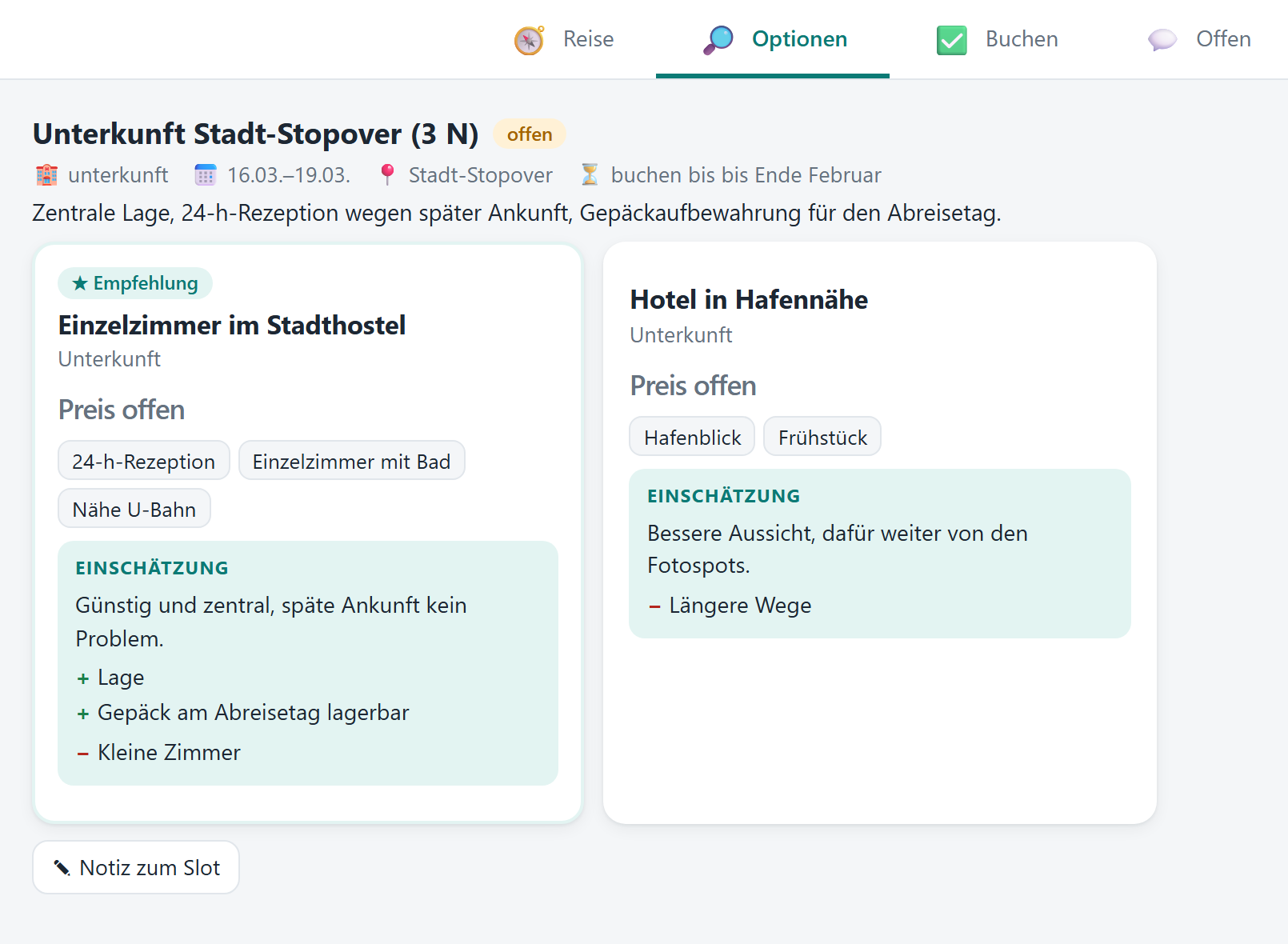
The planning produces four things that I actually use. The cockpit and logbook show sample data with made-up places, the map shows my real route without dates.
The cockpit puts two or three options side by side for each decision, each with an assessment, pros and cons. I give a thumbs up, click “I’ll take it” or add a note, and one button sends everything back to the chat at once. That is how I decided on the accommodation and transfers for this trip.
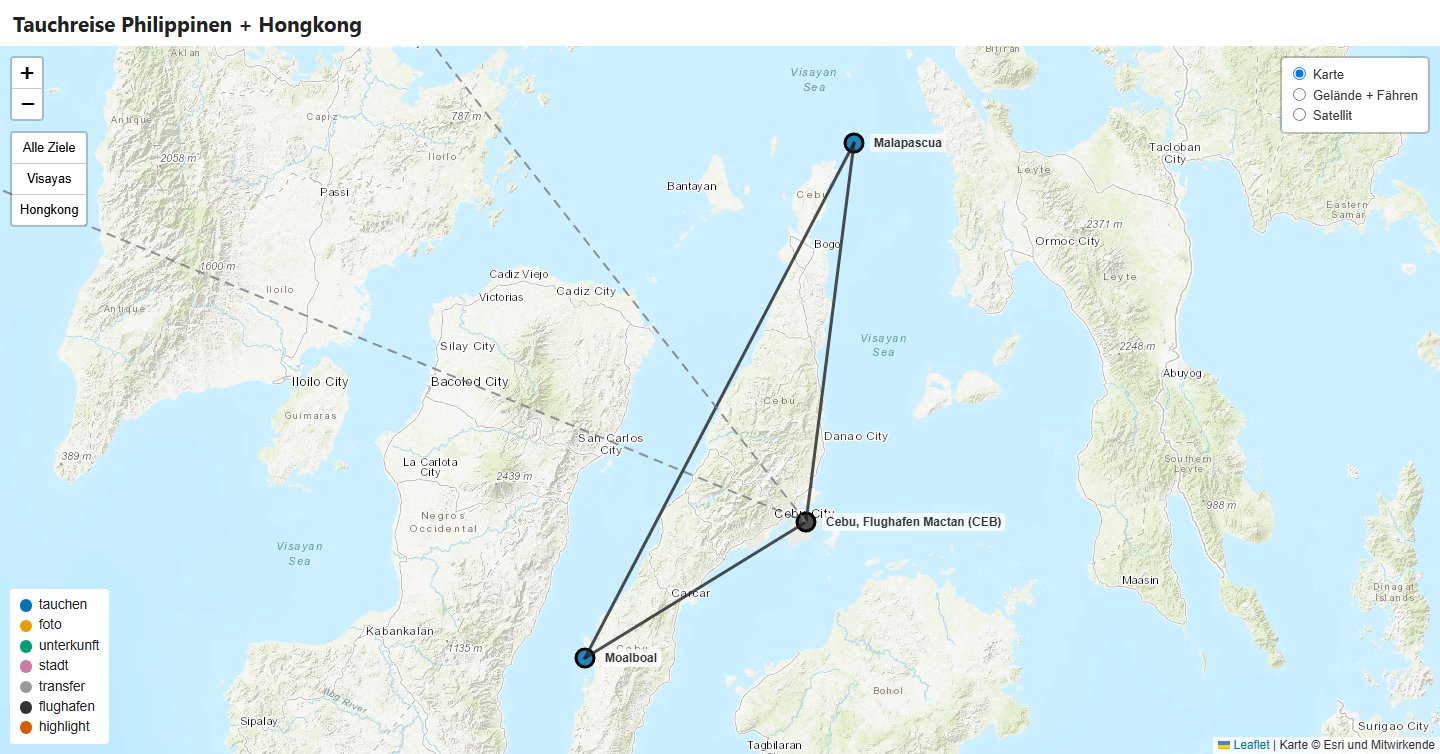
The map shows all stops, transfers and variants with a timeline, plus a file for Google Earth.
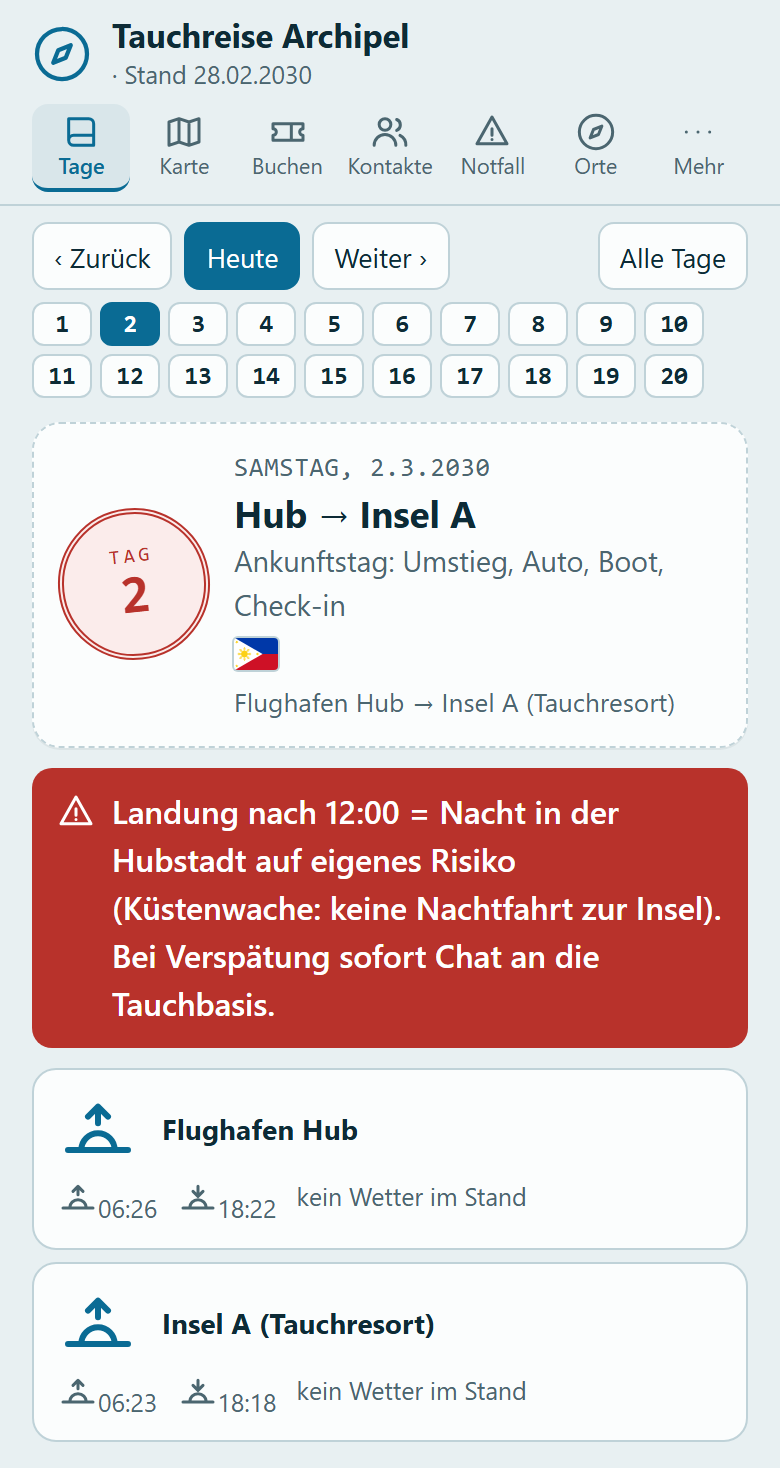
The logbook runs offline on the phone, day by day: what’s coming up, when the sun rises, whom to call, what to do in an emergency. Every entry can be expanded to show where the information comes from.
The booklet is a PDF for family and friends, one stop per page, without costs or contact details. It exists because the first, rather dry version showed too little of what I had planned.
Claude built the interfaces, by the 80/20 rule. Some of it would pass as “AI slop” visually. Content and sources mattered more to me than looks.
Agents, chat or travel agent
Of course I could simply ask Claude where diving is good in November. The answer would come from the model’s training knowledge, meaning texts up to a cutoff date: general, undated, without a source, and forgotten again in the next chat. My system instead loads profile, knowledge and plan from files and researches current information on the web.
| Chat AI | Travel agent | Agent team | |
|---|---|---|---|
| Knows my taste | no explain it every time | partly depends on the agent | yes rules with evidence |
| Current information with sources | partly depends on web search | partly catalog and experience | yes source and date per statement |
| Works out connections and deadlines | partly without a cross-check | partly for package tours | yes the whole chain with Plan B |
| Plans diving and photo details | partly | partly with a specialist operator | yes nitrox, camera room, light |
| Reachable on the road, even at night | yes | partly emergency number | yes via the phone |
| Learns from feedback and context | no | partly a good agent does | yes prediction vs. verdict |
| Books and handles problems | no | yes | no I book myself |
A good travel agent books for me and helps when something goes wrong. My system can’t do that, and I don’t want to hand it over either. In return it knows my preferences down to the dive center’s camera room, searches in local languages for tips from locals, gives a counterargument for every recommendation and is reachable on my phone at two in the morning. So it replaces the travel agent right up to the checkout.
Replanning from the phone
For the road there is a separate command, /adapt. Its instructions assume that I write from my phone, often briefly, often early or tired. So the answer is short: what’s going on, two concrete options with their consequences, one recommendation. Only after I have chosen does Claude change the plan, logbook and map. On this trip I rearranged my dives this way.
On the road the system is also my notebook with a memory. I take a photo of the price list at the dive center, send it into the session, and it becomes a knowledge entry with my photo as the source. That a tunnel at a dive site is closed goes into the knowledge the same way.
For medical emergencies or a security situation, /adapt has a separate mode: no options, no research, only the emergency number, clinic and hyperbaric chamber from the research done beforehand, with the date of the information, and a request to get in touch once I am safe. If nothing documented is there, the system says “not documented” instead of giving a number from memory.
In plain words
In Claude Code you can save recurring procedures as a command, a kind of stored recipe in a text file. When I type /adapt, Claude reads that recipe and follows it: answer briefly, two options, one recommendation, change nothing until I have chosen. So I don’t have to explain it every time, least of all at five in the morning from my phone.
Dive deeper
/adapt deliberately reads little: from the plan only today and the next two days, the end of the trip log, the section with bookings and cancellation deadlines, and only the taste rules the disruption touches. After that at most three short searches, for example weather, ferries and flight status. It only starts a specialist when there is a real need.
The answer has a fixed format of about twelve lines at most:
- one sentence on the situation, with time and source
- option A and option B, each with consequences for the next days, bookings and cancellation deadlines, and what I give up for it
- a recommendation with a one-sentence reason
- at most one open point
Nothing is written until I have chosen: then plan, logbook and map are updated, plus a commit suggestion.
Under the hood
From here on it gets technical. It all started with a long chat with Claude. At some point early decisions slipped out of view, and a chat that keeps getting longer is not a lasting solution. Almost everything that follows is an answer to that problem. Since Claude Code is my usual development environment anyway, I moved there.
Since then the system has been a Git repository, meaning a project folder with version history, full of configuration for Claude Code: agent definitions, skills (stored procedures like /adapt), rules, two hooks (small programs that run automatically at fixed points), a few Python scripts and a lot of Markdown. No server code of its own, no database.
Five phases, five commands
Every trip goes through the same phases:
/pitchassesses an idea, with a counterargument and a travel-season traffic light for all twelve months./rahmen(German for “frame”) fixes route, flights and accommodation in three research waves. Then I approve the frame. Nothing moves on before that./detailplans day by day and generates the cockpit and logbook./adaptis for the road./retrocollects my verdict after the trip and compares it with the predictions.
One orchestrator, seven researchers
The orchestrator runs on Opus, the strongest model, and handles small things itself. Everything that needs a lot of reading goes to the workers, the researchers. The choice of model follows a ladder: Haiku, the smallest model, does the broad, raw search in local languages. Sonnet does targeted research and double-checks. Opus judges my taste, and only on short lists.
One rule proved itself early: workers never judge by taste. The dive specialist filters by hard criteria, for example whether a site is deeper than 30 meters. Whether I will like a dive center is not its call.
In plain words
Anthropic offers its AI in three sizes. Haiku is small, fast and cheap, Sonnet is the all-rounder, Opus is the strongest and most expensive model. It’s like a team: a broad search across twenty sources doesn’t need a department head. The question of what really suits me does.
Dive deeper
In Claude Code every worker is a subagent: a Markdown file with a header that sets name, description, allowed tools, model, reasoning effort and preloaded skills. The dive specialist, for example, may search, read web pages and write files, runs on Sonnet with medium effort and preloads the shared protocol for briefs.
Every subagent works in its own context. It sees nothing of the conversation between me and the orchestrator, and only its result comes back. The tool list controls what an agent can do at all. The evaluator, for example, has no web tools whatsoever. At most three workers run at the same time.
Agents share no memory
That way 50 pages of research stay in a file, not in the conversation.
Every worker starts without prior knowledge and only knows what is in its brief. The orchestrator sends a brief that always has the same four parts: goal, context paths, output file and done criteria. What is never in it: which option the orchestrator prefers.
The worker writes a result file and reports back in 15 lines at most. The orchestrator first reads only this report and the summary of the file. That way 50 pages of research stay in a file and not in my conversation. All workers share the same ground rules: existing knowledge first, then the web, official sources before guidebooks before personal reports. And if a site blocks access, nothing gets worked around: no login, no proxies.
Dive deeper
The done criteria are a checklist that can be verified. For the dive specialist, for example, they say that for every dive center nitrox, camera room, group size, guides and oxygen must either be documented or explicitly marked “not documented”, that the no-fly time after the last dive comes from an official source, and that the nearest hyperbaric chamber is named.
The result file starts with a summary of ten lines at most: answer, recommendation, biggest uncertainty. After that come a findings table, details, sources with retrieval date and type (official, guidebook, personal report) and open points. Facts that are useful beyond the trip also go into an inbox. The report to the orchestrator gives the status (done, partial, blocked), at most five key findings, the files and open questions.
The evaluator never learns what the orchestrator wants
In its definition I described the evaluator as my advocate. It reads my profile, my taste rules and the candidates and judges. It can’t research, it doesn’t even have the tools. It knows neither the orchestrator’s preference nor the results of earlier runs, and every shortlist gets its own fresh run. It may also say no to all candidates. I have not measured whether this really helps against people-pleasing. It is a precaution.
On top of that there is the review board with several seats, each with one rubric, for example logistics, safety, photographer, diver. Each seat sees only its rubric and the plan and returns 25 lines at most. The orchestrator sorts the findings by place in the plan and names conflicts between the seats openly. I decide point by point: adopt, reject or later.
In plain words
Language models tend to tell you what you want to hear. If the brief says “I like option A”, the model often likes option A too. This is called sycophancy, roughly: people-pleasing. That is why my evaluator never gets to see what the orchestrator prefers. Like an assessor who doesn’t know which offer the boss likes.
Only what’s needed stays on the desk
The most expensive thing in a system like this is the context, meaning everything the model has in front of it for an answer: the conversation so far, every open file, every instruction. It helps to think of it as a desk. The more is on it, the messier it gets. Answers get slower and more expensive, details get lost, and at some point the desk is full. The repository is the filing cabinet next to it: profile, knowledge, plans and rules sit there in folders, and for each task only the file that is needed right now goes on the desk.
Long sessions end with /handoff – the next one starts fresh.
Almost every design decision in the repo aims to keep the desk clear:
- At startup, a hook loads only the handover note (60 lines at most), the next roadmap items and the number of unread findings.
- Format rules for trips, profile and knowledge only load when a matching file is touched.
- The knowledge has an index with one line per file. Agents read the index first, then only the section they need.
- Extensions like the flight search are attached only to the worker that uses them.
That way a fresh session starts at about 35,700 tokens, the word pieces a model reads and is billed in. That is a lot and can surely be optimized. But a good part of it is tailoring to me, and that should stay.
Dive deeper
In Claude Code the startup hook is a SessionStart hook. It runs at startup, on resume, after a clear and after compacting a session, and adds its text to the context. The format rules are rule files with a paths: entry in their header, such as trips/**. Claude Code only loads them when a file under that path is touched.
Long sessions end with /handoff: a handover note of 40 lines at most, and the next session starts fresh instead of dragging a full desk along.
Knowledge needs a source, rules need confirmation
Knowledge: no source, no entry. Raw findings from the workers land in an inbox, and only the orchestrator moves them into the actual knowledge. A hook checks before every write that each statement has a source. I don’t rely on the model’s discipline for this. My own experience counts as a source but stays “unverified” until an official or a second source confirms it. The hook has one deliberate weakness: if it crashes itself, it lets the change through, so that a bug in the hook doesn’t block the whole session.
Taste: one data point is not a rule. My profile contains taste rules with evidence. Raw signals go into the feedback log, with a verdict and my own words, for example my verdict on a ferry without a reservation on a trip to Norway: too much uncertainty. What I say explicitly becomes a rule right away. What the system only infers stays a hypothesis until there are two independent confirmations and I agree. On Malapascua, for example, the guess was added that I like shallow dive sites better.
Then there is the comparison between prediction and verdict. After the trip, /retro puts my verdicts next to the evaluator’s predictions and calculates hit rate and deviation. The retro of the Norway trip produced 24 verdicts (14 very good, 8 okay, 2 poor), one new rule and two new hypotheses.
In plain words
A hook is a small program that runs automatically at a fixed point, for example every time before the AI saves a file. It works like a bouncer: the AI can neither talk it round nor forget it. A model can overlook an instruction in the text, but it can’t get past a hook.
Dive deeper
The source hook is a PreToolUse hook on the tools for writing and editing. Before every write, Claude Code calls a Python script and passes along what is about to be written. The script only checks entries in the knowledge folder, and only those that are new or changed. A valid source is a URL, a path in the repo or an evidence word such as “observation” or “measurement”. If it is missing, the script ends with exit code 2, and the error message including the rule goes back to the model. The model has to supply the source or drop the entry.
The hook only checks whether a source is there, not how good it is. An example from my knowledge folder: the thresher sharks are said to have moved from a deeper to a shallower site. So far this is backed by only a single article. The entry gets through, but is marked “unverified” and “volatile”. For me, “verified” means a primary source or two independent sources. That second level is a rule in the instructions, not a hook.
The AI keeps the data, scripts draw
Same data, same result – the model never draws HTML itself.
Python scripts without external dependencies generate the map, cockpit, logbook and booklet. The model only maintains simple data files with stops, legs and route variants. Having the model generate HTML every time would be expensive and error-prone. This way an update costs a few lines of data and one script run, and wrong coordinates show up on the map right away. Another script calculates sun times, golden and blue hour, moon phase and weather for every stop, and the photo specialist plans the light windows from that.
The booklet renderer also checks all texts for amounts of money, payment status, phone numbers, email addresses and street addresses, and aborts with a list of hits. The booklet goes to family and friends, and I’d rather rely on a regular expression than on a model’s attention.
In plain words
The AI only fills in a form: where am I when, how do I get from A to B, what is already booked. The map, cockpit and booklet are drawn by the same fixed program every time. That is cheaper than letting the AI write a whole web page each time, and it looks equally clean every time.
A server at home, the phone as remote control
I don’t carry a laptop on the road. The system runs on its own virtual machine (VM) on my home server. On the phone I open the Claude app, “Code” tab, and I’m in the same environment as at my desk.
An AI with shell access should not wander through the home network. So the VM is locked down:
- Remote Control only opens outbound HTTPS connections, there are no open ports.
- A firewall lets the VM reach the internet, but not the other devices in the house.
- Claude runs as its own user without admin rights. The VM’s only access to GitHub is a key that works for this one repository.
Laptop and VM sync through Git: git pull at the start, push at the end, never at the same time. I learned that the hard way when the VM, working on an old state, processed the same inbox a second time. As a fallback there is a cloud session on claude.ai, but without the private files.
In plain words
My server at home calls Anthropic itself and keeps the line open. Nobody can call in from outside, there is no open door into the home network. The phone sends my message to Anthropic, the server picks it up there and answers the same way. To me it feels like sitting at my desk.
Dive deeper
On the VM a systemd service starts claude remote-control in a tmux session and restarts it if it crashes. GitHub access is a deploy key with write access to this one repo. There are no credentials for other systems on the VM.
Four mistakes that became rules
All four are now listed with symptom and workaround in a tool log in the repo:
Silent failures. The flight worker suddenly had no flight search anymore, without an error message. Claude Code trusts projects per path, and the path had been registered once with a lowercase c:\ and once with an uppercase C:\. I only found it in the debug log.
Agents with an old memory. A resumed worker got new tools but kept its old instructions and reinterpreted what it had done in the first run. Since then the rule is: don’t trust what a resumed worker says about itself.
Negative findings. A web search reported “no reports” of a security incident that the responsible authority had in fact reported. Since then “nothing found” does not count as evidence.
The usage limit. Many parallel workers burn through the quota. Their progress is kept, though, and after the reset they carry on.
Build it yourself
You don’t need seven specialists for this. A sensible start, in this order:
- A short
CLAUDE.md: session start, folder structure, roles, hard rules. Under 100 lines. - A profile: hard constraints (for me: dive certification, gear, vacation days) and a few taste rules with evidence.
- Two or three workers for the topics that take the most research, with a shared protocol for brief, result file and report.
- A knowledge folder with an index and an inbox, plus the rule “no source, no entry”. As a hook, if you mean it.
- Data instead of HTML: one file with stops and legs and a small script that turns it into a map.
- Handover instead of a marathon session: a handover note, a hook that loads it at startup, and a
/handoffcommand. - Later: evaluator with predictions and retro, review board, access from the phone.
You need Claude Code with a subscription, Python 3.11 or later and Git. I run everything on a Claude Pro subscription, and one trip took more than 50 worker runs. Pro is enough as long as you don’t want to plan the whole vacation in a single session. On the road the quota is not an issue.
A stripped-down version without my data exists as a starter kit: for several travelers with separate taste profiles, with modules for diving, photography and drones, and an /onboarding that walks you through the setup in about 20 minutes. It is not public. If you’d like to try it, feel free to get in touch.
The first chain held
The system works, and its biggest value is how closely it fits me: my vacation days, my gear and my pain threshold at 33 hours of travel. If I did it again, I would change one thing above all: go for graphics and prepared details earlier instead of text in the chat. I simply take in information better that way, even if it costs Claude more tokens.
Whether the evaluator really knows me will only show in the retro of this trip. I’m even more curious what the system will look like after trip three or four. The first chain held, in any case: when the sun went down on Malapascua, I was already at the dive school renting a BCD and a wetsuit.
FAQ
Do I need a server at home?
No. Everything works the same on a laptop. The server is only there so I can keep planning on the road without a laptop.
How much do I need to be able to program?
Agents, skills and rules are Markdown. Claude wrote the Python scripts, I wrote the briefs and checked the results. You should be comfortable with Git and a command line, though.
Where does my data end up?
The conversation log is with Anthropic, the repository is private on GitHub. The flight search queries Google Flights, the weather data comes from Open-Meteo. Booking codes and invoices sit in a separate private folder.
Does this work without diving?
Yes. Diving and photography are separate specialists and review seats in my setup. In the starter kit they are modules you can switch off. The core, made of orchestrator, briefs, sourced knowledge and feedback loop, doesn’t depend on them.
More on the topic: how I take photos underwater is covered in the article on underwater photography. How this site is built with a similar team of AI agents is in AI-assisted web development. More AI projects are in the AI section.